An outdoor fireplace in Taylor is a year-round anchor, useful on cool evenings and the roughly 12 sub-freezing days a season as much as on a mild spring night. This site is a matching service: we connect you with local Williamson County pros who quote your fireplace or fire feature, and you pick the builder. We do not build it. Whether you want masonry that holds heat or a gas unit that starts with a switch, the pros who quote you know this clay ground and what a heavy structure does on it.
Why this is different here
A masonry fireplace is heavy, and heavy is the whole problem on Taylor's clay. The ground east of the Balcones Fault is deep Houston Black clay, no bedrock within 80 inches, very slowly permeable with high runoff. A chimney mass concentrates load on a small footprint. Footings need to reach below the active clay or sit on piers, and the base has to shed water, or the freeze-thaw of about a dozen sub-freezing days a season plus a wet May will find a crack.
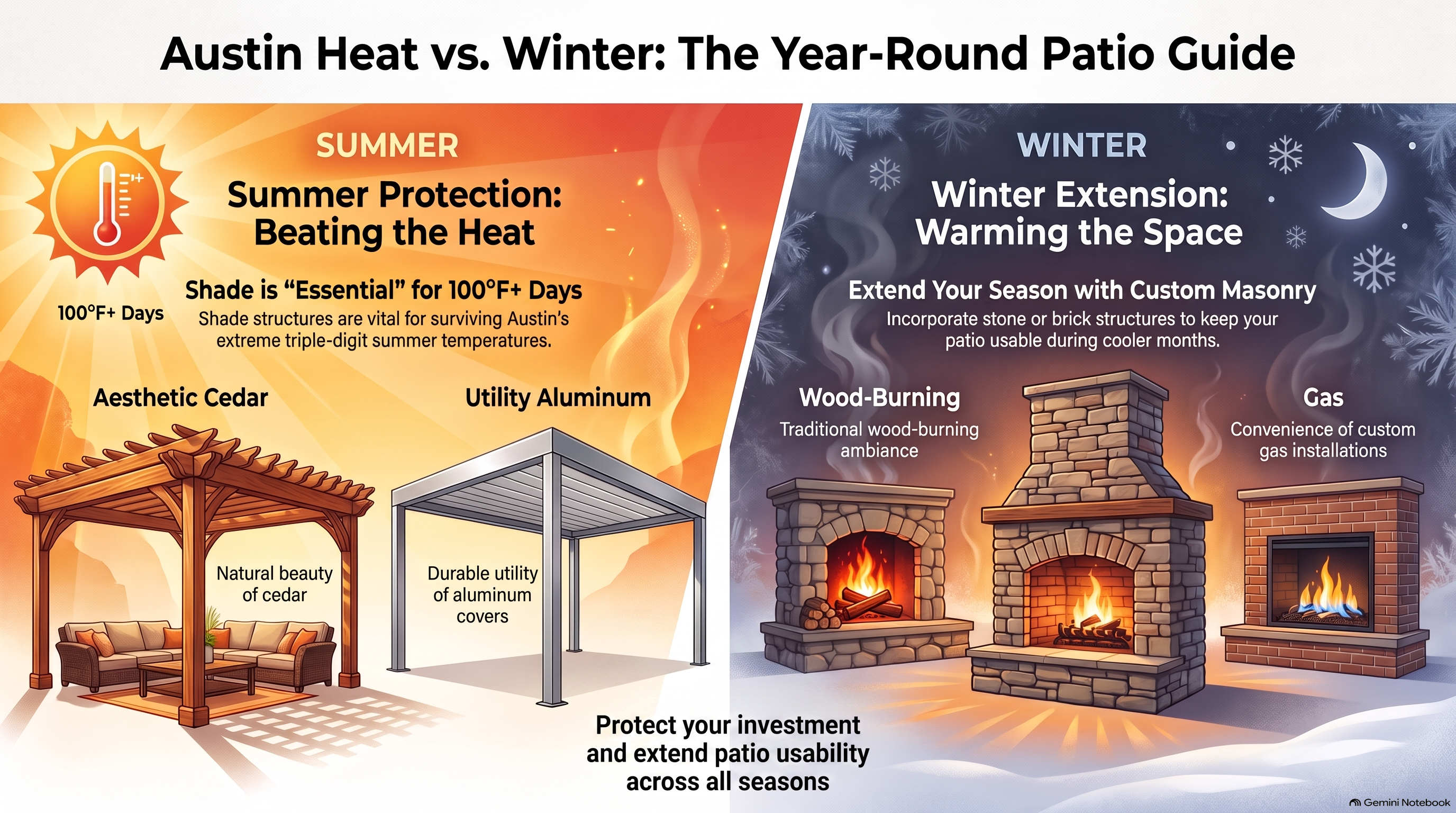
Fire type follows from that. A wood-burning masonry fireplace brings a real foundation and clearance requirement; a gas unit or a fire feature uses a lighter footing and a fuel line, and needs ventilation. Whichever you choose, the structure will be permitted under the 2018 International Codes Taylor adopted, so the plan should show clearances and the footing detail.
Screen and clearance rules are not decoration. Ember screens and the required distance from the flame opening to combustibles keep a fire from reaching a roof edge, a pergola, or dry grass. On these lots, with a summer that runs to 96 to 97F and long dry stretches, that margin matters.
The burn season is long but the summer is not the point. With average highs near 96F and a UV index of 11 to 12 from April through August, most Taylor use happens on fall and winter evenings and on mild spring nights. Gas offers instant heat and no ash; wood gives more radiant warmth and needs a covered firebox. Rain of 33 to 35 inches a year means any firebox, flue and chimney cap have to shed water.
City rules shape placement. Taylor caps accessory structures at 15 feet and allows them only in side or rear yards, clear of setbacks and easements. On a historically zoned property, a Certificate of Appropriateness comes from Planning and Development Services before a building permit is issued. The one-permit system also means the mason, electrician and gas fitter must be on one application.
How It Works
- Tell us about your outdoor fireplaces project
- Get matched with up to 3 Taylor pros
- Compare quotes and choose the best fit
Materials, Installation & Quality
Our matched Taylor pros use professional-grade materials and techniques — proper site prep, reinforcement, control joints, and curing methods that stand up to local conditions. They do not cut corners, and they do not use substandard mixes or shortcuts that lead to early failure.
Local rules and permits in Taylor
The rules below come from the town and county offices that issue the permits, and they change what a crew can start on and when. Ask any pro you talk to which of these applies to your lot before work begins.
Height and Yard Limits
Taylor allows accessory structures, including outdoor fireplaces and chimneys, only in side or rear yards, clear of setbacks, and caps them at 15 feet in height. That cap can affect a tall chimney and any chimney cap. Confirm the measurement and your yard's limits with the City of Taylor Planning and Development Services Building Inspection Division before you finalize the height.
Certificate of Appropriateness on Historic Properties
On a historically zoned property, the City of Taylor Planning and Development Services requires a Certificate of Appropriateness before a building permit is issued for alterations, including fences and accessory structures. A fireplace counts. That review happens first, so allow extra weeks in the schedule and confirm your zoning status with the department before you design the hearth.
One Permit for Masonry, Gas and Electrical
The City of Taylor Building Inspection Division requires all contractors and subcontractors on one building permit before it is issued. An outdoor fireplace often brings a mason and, for a gas log set or built-in lighting, a gas fitter and an electrician. Name them all on the application, and start within six months or the permit becomes invalid.
Protected Trees Near the Hearth
Taylor's protected-tree ordinance in chapter 8 of the Zoning and Development Code covers trees 8 inches DBH or larger, and oak wilt risk means oaks should be pruned only in the dormant cold or the hottest summer, with cuts painted. Removal can require replacement at 1:1 to 3:1 or mitigation at $150 per diameter inch. Check with the Building Inspection Division before you clear anything near the site.
Common questions
Where can I put an outdoor fireplace in Taylor?
Only in the side or rear yard. Taylor treats an outdoor fireplace as an accessory structure, so it must clear setbacks, avoid any utility, drainage, water or sewer easement, and stay under 15 feet in height. Check your plat for easements, then confirm the plan with the City of Taylor Planning and Development Services.
Is a gas or wood-burning outdoor fireplace better in Taylor?
It depends on how you want to use it. Gas gives instant heat, no ash and simpler controls, which suits short winter evenings. Wood gives more radiant warmth and a real fire, but needs a masonry firebox, a screen and more maintenance. A local pro can match the choice to how often you expect to sit outside.
Do I need a permit for an outdoor fireplace in Taylor?
Usually yes. The City of Taylor Planning and Development Services Building Inspection Division issues the permit, and every contractor and subcontractor has to be listed on one application before it is issued. If your property is historically zoned, a Certificate of Appropriateness is required first, and the permit expires if work does not start within six months.
Related Services in Taylor

Ready to find a pro in Taylor? Call (943) 888-0144 or fill out our contact form.